
Inverse Rendering for Discrete X-Ray Computed Tomography

Abstract
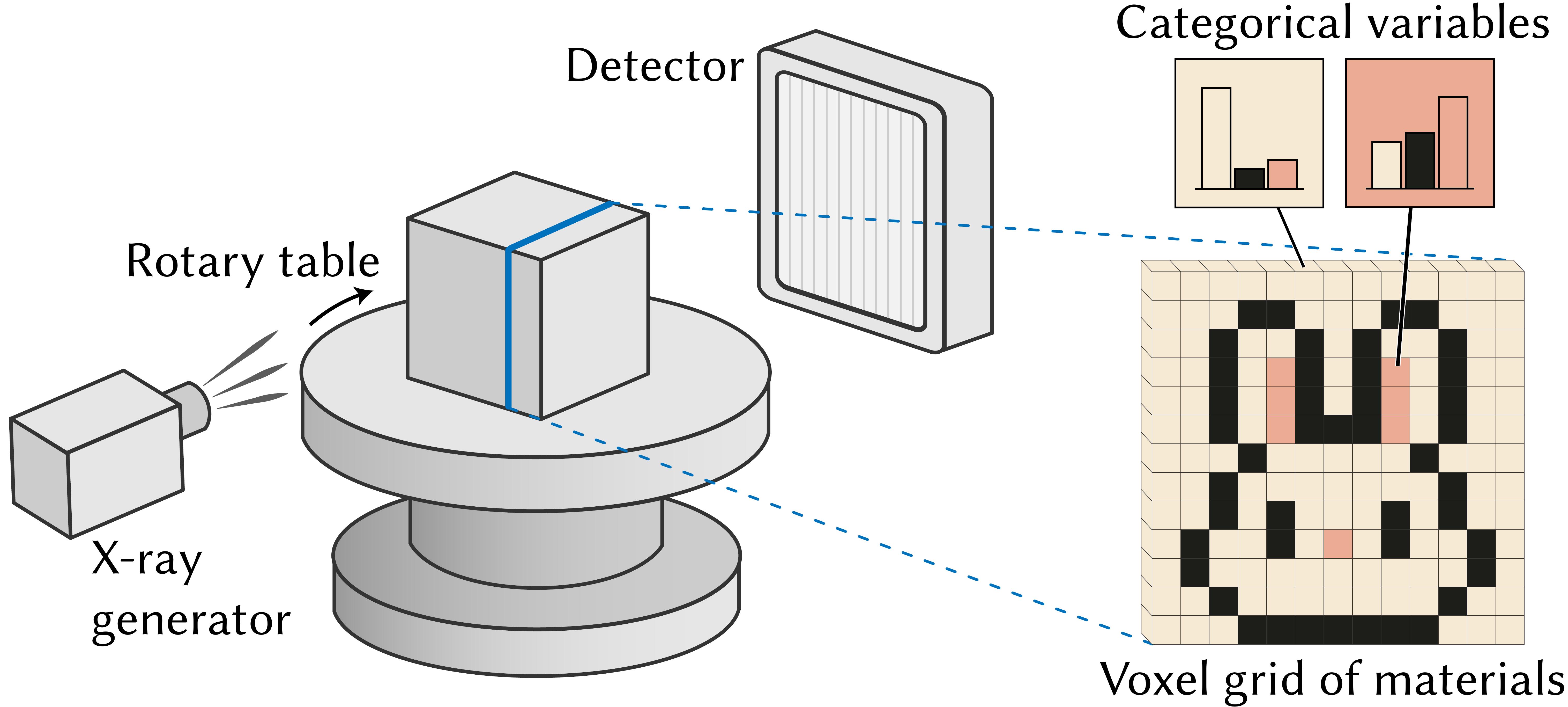
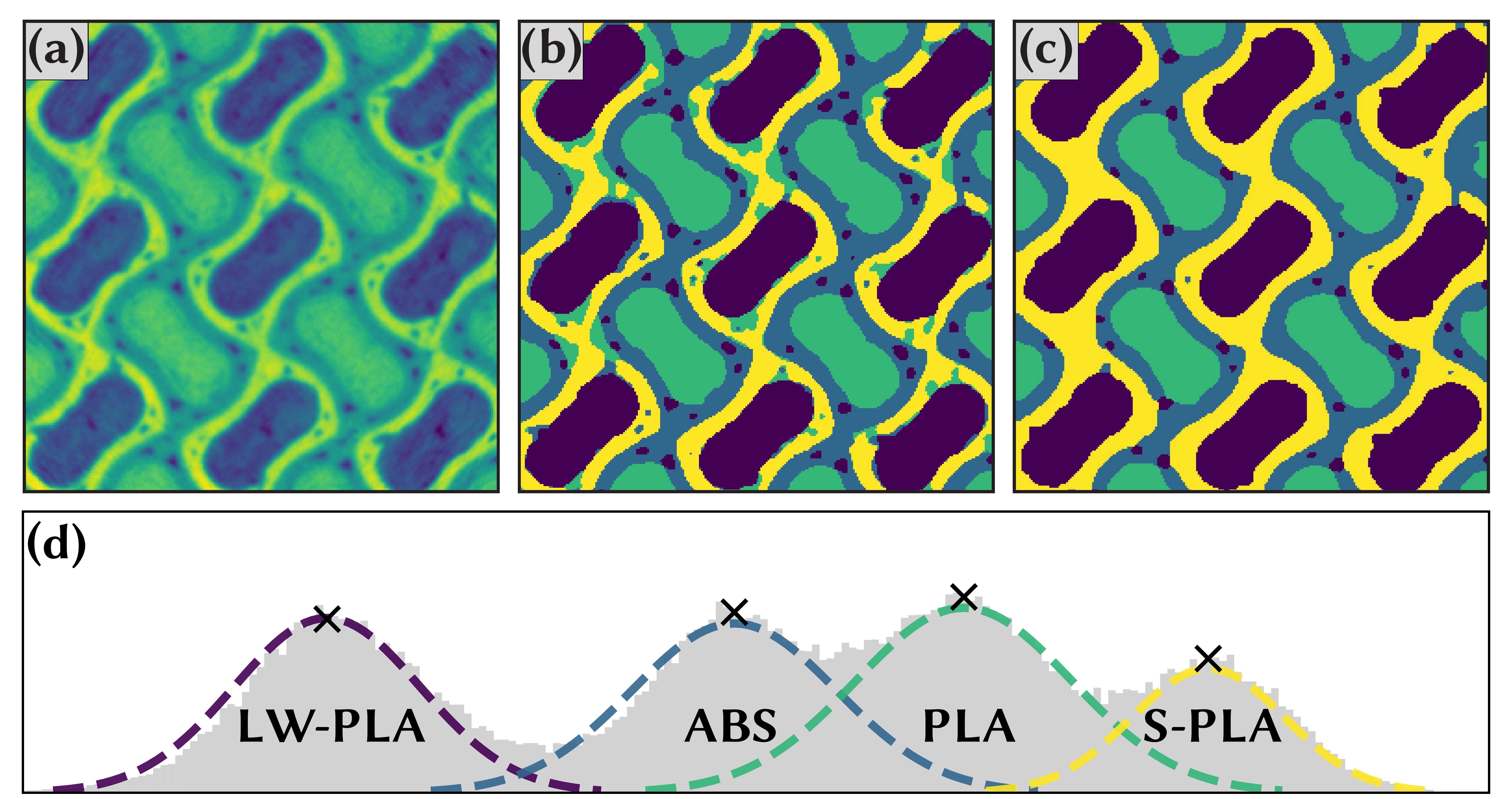
Discrete X-ray tomography reconstructs the internal structure of an object from X-ray projections, assuming that the volume is composed of a discrete set of known materials (e.g., steel, aluminum, and air). This is generally straightforward when many projections are available but becomes increasingly ill-posed as their number decreases. Discrete tomography has been extensively studied over the past five decades, resulting in a range of mature reconstruction algorithms.
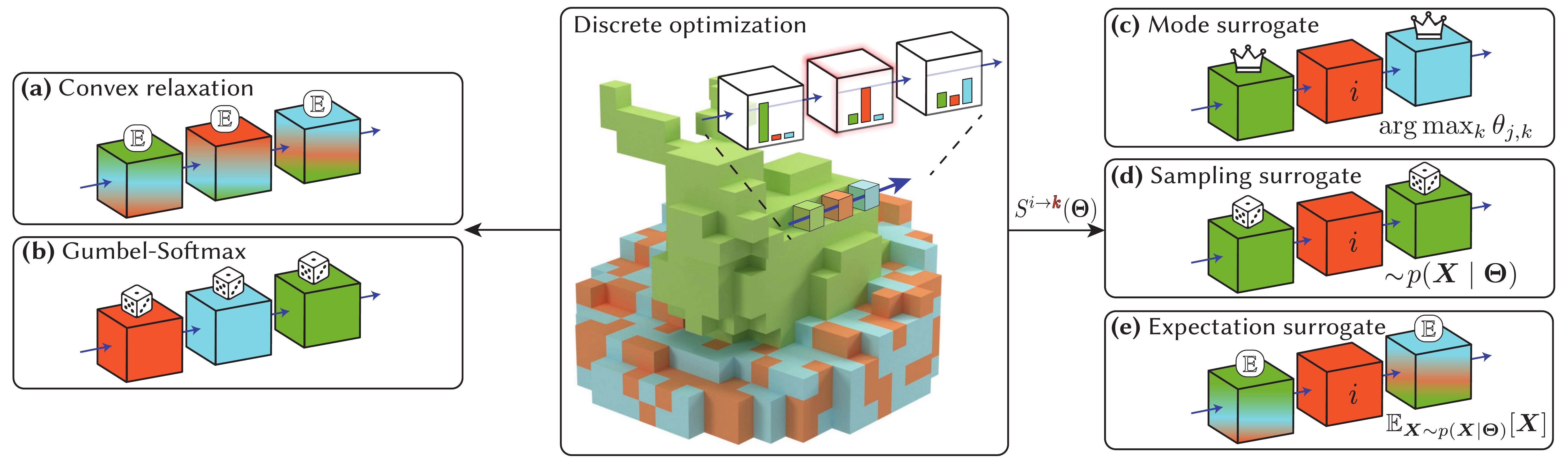
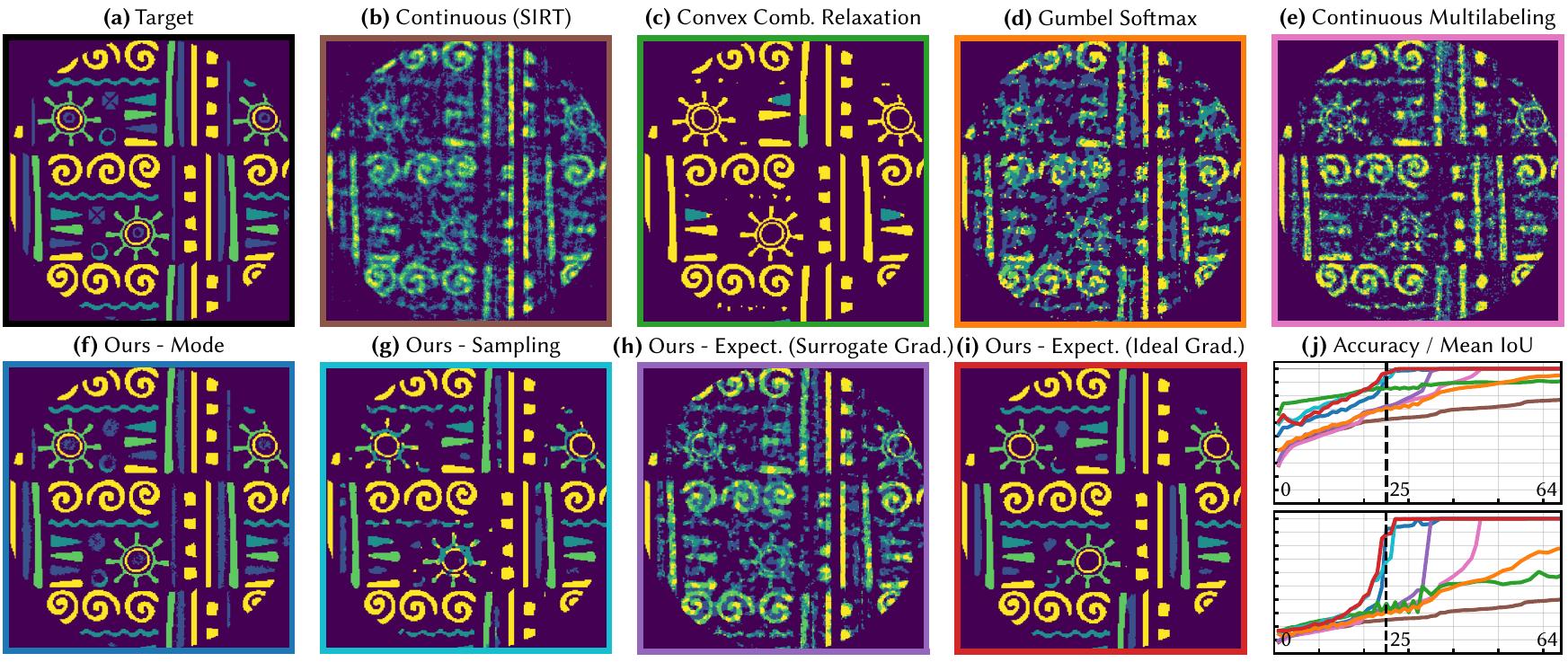
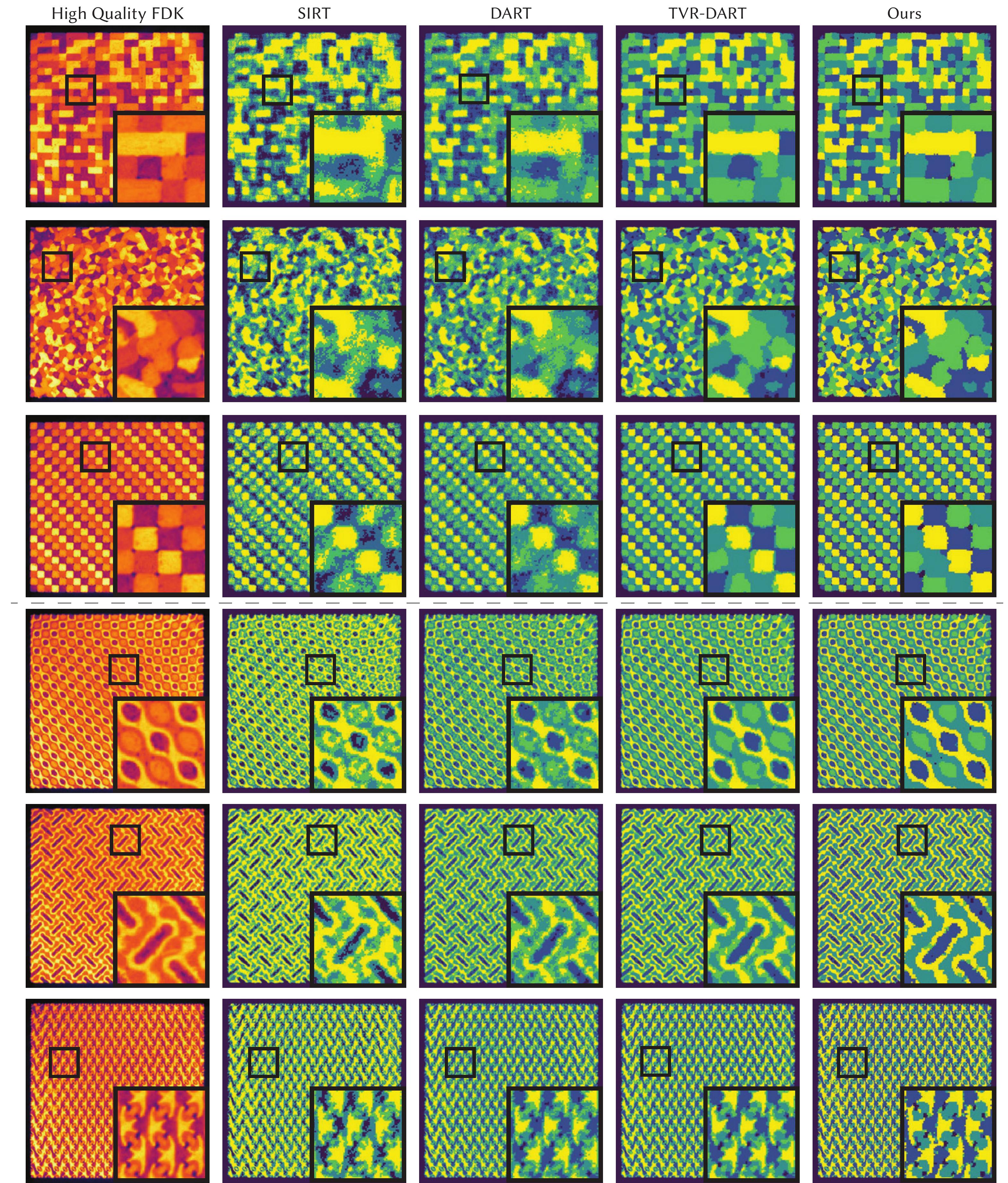
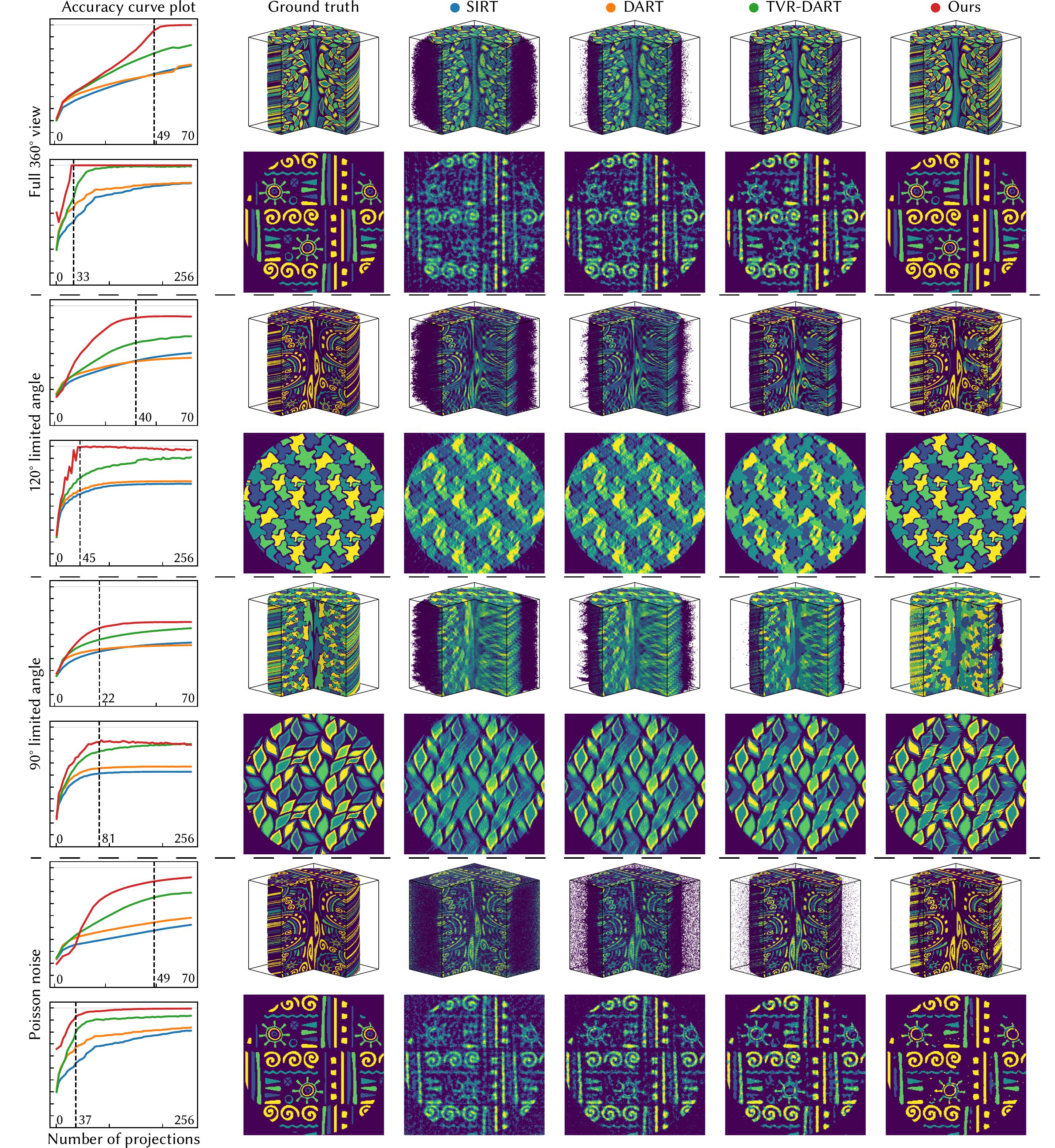
In this work, we introduce a new reconstruction method that draws inspiration from both classical computed tomography and recent advances in inverse rendering, demonstrating that a remarkably simple gradient-based inversion can significantly surpass the reconstruction quality of standard methods such as SIRT, DART, and TVR-DART. Our method represents each 3D location as a probability distribution over the set of known materials and minimizes a volumetric loss that encourages consistency with the measured projections. It supports nonlinear effects such as volumetric scattering and is simple to optimize and parallelize on compute accelerators.
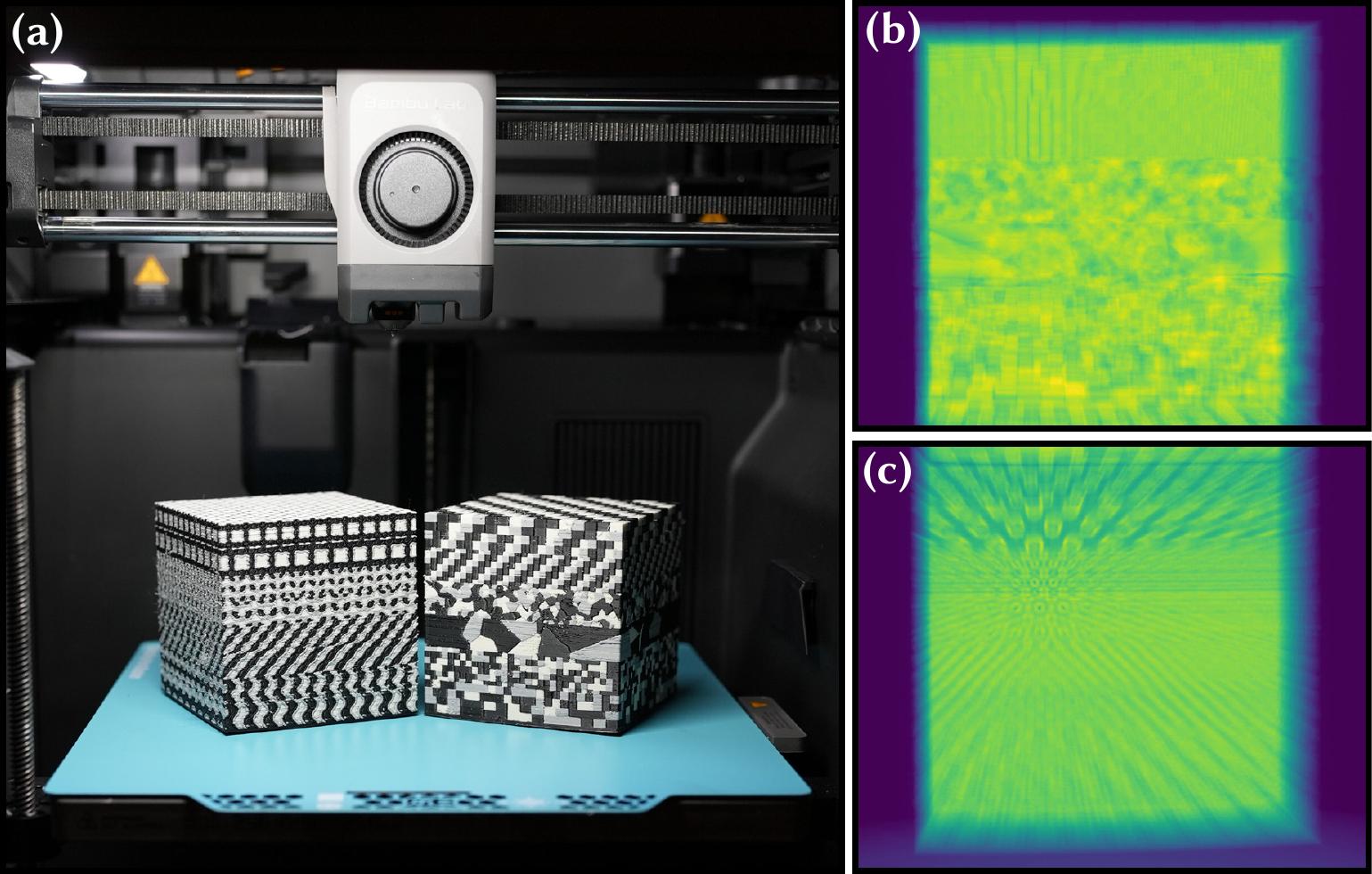
We evaluate our method on challenging 2D and 3D benchmarks, demonstrating superior performance particularly in sparse and limited-angle scenarios, where traditional techniques struggle with ambiguity.
Figures
Text citation
Lovro Nuic, Ziyi Zhang, Korbinian Sager, and Wenzel Jakob. 2026. Inverse Rendering for Discrete X-Ray Computed Tomography. In Transactions on Graphics (Proceedings of SIGGRAPH) 45. 16.
BibTeX
@article{Nuic2026DiscreteCT,
    author = {Lovro Nuic and Ziyi Zhang and Korbinian Sager and Wenzel Jakob},
    title = {Inverse Rendering for Discrete X-Ray Computed Tomography},
    journal = {Transactions on Graphics (Proceedings of SIGGRAPH)},
    volume = {45},
    pages = {16},
    year = {2026},
    month = jul,
    doi = {10.1145/3811391}
}