
A General Framework for Pearlescent Materials
Abstract
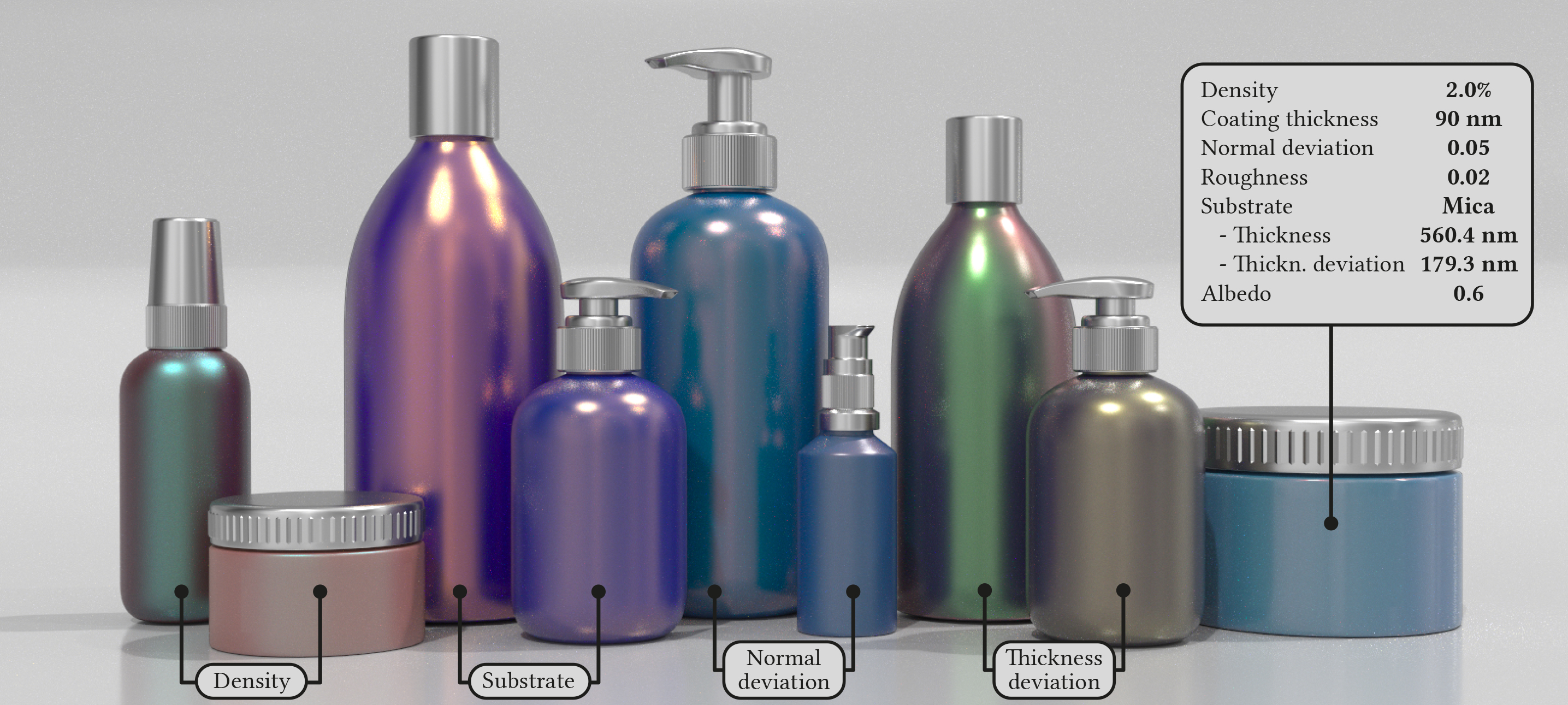
The unique and visually mesmerizing appearance of pearlescent materials has made them an indispensable ingredient in a diverse array of applications including packaging, ceramics, printing, and cosmetics. In contrast to their natural counterparts, such synthetic examples of pearlescence are created by dispersing microscopic interference pigments within a dielectric resin. The resulting space of materials comprises an enormous range of different phenomena ranging from smooth lustrous appearance reminiscent of pearl to highly directional metallic gloss, along with a gradual change in color that depends on the angle of observation and illumination. All of these properties arise due to a complex optical process involving multiple scattering from platelets characterized by wave-optical interference. This article introduces a flexible model for simulating the optics of such pearlescent 3D microstructures. Following a thorough review of the properties of currently used pigments and manufacturing-related effects that influence pearlescence, we propose a new model which expands the range of appearance that can be represented, and closely reproduces the behavior of measured materials, as we show in our comparisons. Using our model, we conduct a systematic study of the parameter space and its relationship to different aspects of pearlescent appearance. We observe that several previously ignored parameters have a substantial impact on the material's optical behavior, including the multi-layered nature of modern interference pigments, correlations in the orientation of pigment particles, and variability in their properties (e.g.~thickness). The utility of a general model for pearlescence extends far beyond computer graphics: inverse and differentiable approaches to rendering are increasingly used to disentangle the physics of scattering from real-world observations. Our approach could inform such reconstructions to enable the predictive design of tailored pearlescent materials.
Text citation
Ibón Guillén, Julio Marco, Diego Gutierrez, Wenzel Jakob, and Adrien Jarabo. 2020. A General Framework for Pearlescent Materials. In Transactions on Graphics (Proceedings of SIGGRAPH Asia) 39(6).
BibTeX
@article{Guillen2020Pearlescent,
    author = {Ibón Guillén and Julio Marco and Diego Gutierrez and Wenzel Jakob and Adrien Jarabo},
    title = {A General Framework for Pearlescent Materials},
    journal = {Transactions on Graphics (Proceedings of SIGGRAPH Asia)},
    volume = {39},
    number = {6},
    year = {2020},
    month = nov,
    doi = {10.1145/3414685.3417782}
}